
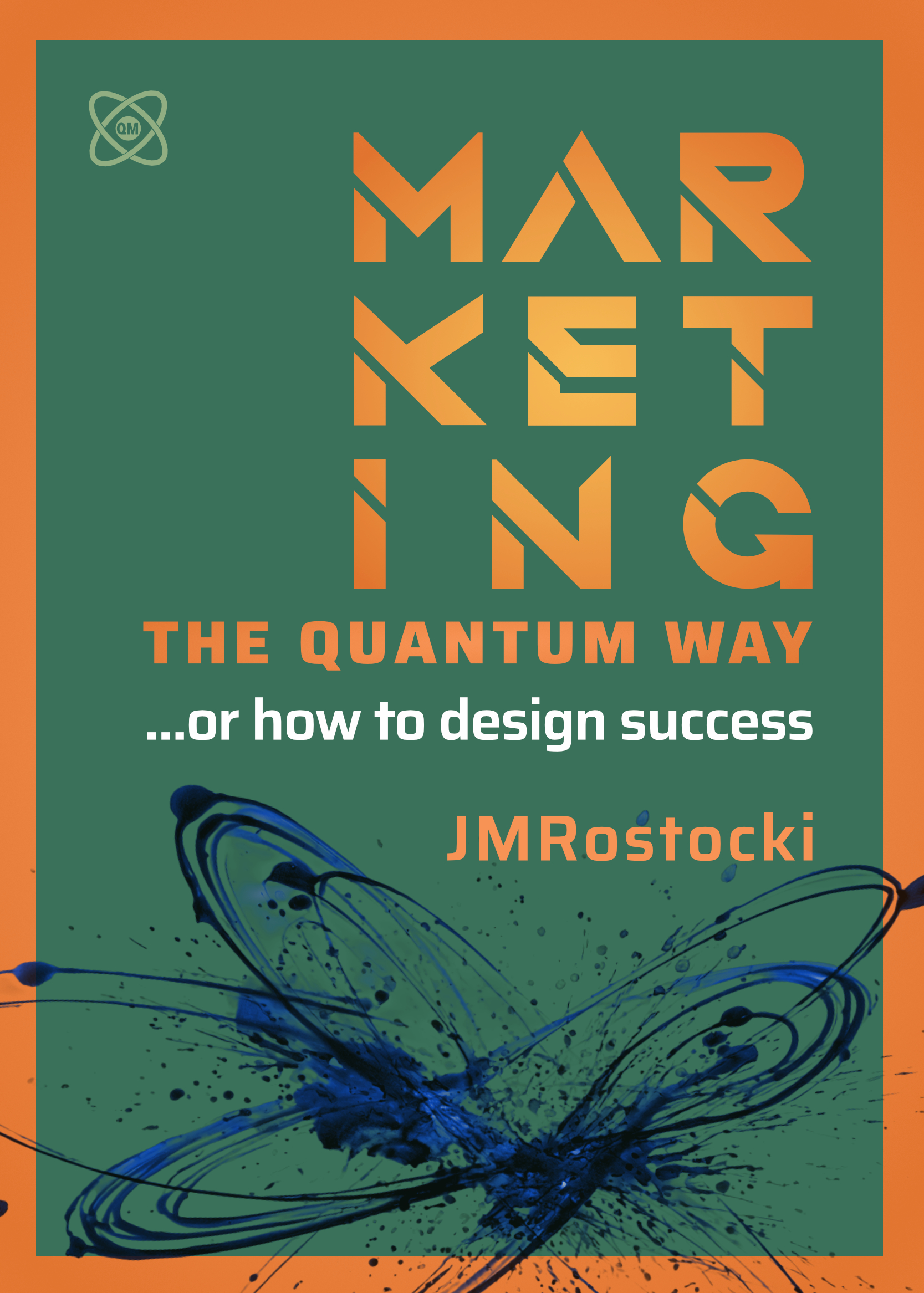
Marketing The Quantum Way
...or how to design success
JMRostocki (Jacek M. Rostocki)
Format: epub / mobi
Create an account to unlock a -20% code. Create account
What this book will give you
A new language. Not another framework, not a set of templates — a language to describe what you see in the market but can’t name today.
19 chapters. Each introduces one quantum phenomenon and shows how it works in marketing — not as a metaphor, but as a decision-making tool.
15 case studies. Real brands, real choices, real consequences. Each case dissected through the lens of Quantum Marketing.
Zero guru-bullshit. No “5 steps to success.” This book doesn’t promise results — it shows you how to design the conditions in which results can happen.
19 chapters
Every title is a provocation. Every chapter is a tool.
Read a sample
Before you buy — read.
Chapter 5
Quantum Tunneling, or the Wall is Just a Suggestion
Vienna, 1987. Dietrich Mateschitz looks at the consumer research for his new project and sees a death sentence. People hate his product; it tastes like medicine. Nobody will buy a can of something that smells like cough syrup and tastes even worse.
Back then, the beverage market was purely Newtonian concrete, poured and shaped over decades by Coca-Cola and Pepsi. The logic was ruthless: You want to sell a liquid in a can? It has to be tasty, evoke family joy, and be cheaper or better than the market leader. That was the potential barrier, which, according to all the laws of market mechanics, couldn't be jumped without having the appropriate mass measured in billions of dollars. Mateschitz didn't have billions. Any classical strategist would have told him: you're going to bounce off that wall and you're a dead man walking.
But Dietrich had no intention of crashing into a wall. He decided to make the wall irrelevant. Before the giants even realized they had a competitor, the blue-and-silver can was already on the other side of the barrier. Mateschitz didn't win with mass; he won with the density of being exactly where others were afraid to look. He tunneled directly into the synapses of exhausted, energy-starved people, entirely bypassing the "carbonated beverages" category.
In classical marketing, we live under the illusion that a market wall is a solid object. We believe that customer loyalty, barriers to entry, or exclusive contracts are solid concrete. It's siege engineering: if you don't have a budget bigger than the leader, the Newtonian model tells you not to approach the gate. And it's right—as long as you believe the world is made up of dead blocks. But market reality is bursting at the seams with events that challenge this belief. What looks like a solid wall from a distance turns out, up close, to be a porous structure full of cracks. Classical physics teaches us to optimize the impact. Quantum Marketing teaches us a technique we call Quantum Tunneling.
In the world of microparticles, an electron can find itself on the other side of an energy barrier even if it doesn't have enough energy to jump over it. It doesn't smash a hole in the wall. It smears out and materializes where, classically, it shouldn't exist. This happens because quantum particles don't have hard edges—their position is a cloud from which a tiny fraction of a tail always sticks out on the other side of an obstacle. If the barrier is thin enough and the particle is in the right phase, a jump occurs.
We call this phenomenon Quantum Tunneling because it precisely describes the survival mechanism in a world dominated by giants. For it to work, the barrier must be thin in one specific place, and your intentions must be crystal clear. Because tunneling is not cheating. It's a deep synchronization with the market's need at a point the leader deemed unworthy of protection. Red Bull tunneled through fatigue by delivering energy; Pierogushka tunneled through the need for absurdity by using its meme-ability; InPost tunneled through the desire to be free from waiting for the postman by giving people freedom. Each of these brands gave up on being a heavy, solid block. They stopped screaming: Buy us! Instead, they became an emission that appeared exactly where a specific deficit existed.
The true marketing strategy of tomorrow isn't about asking: How much reach can we buy for a hundred grand? That's the question of a Newtonian engineer planning their next collision with a wall. The quantum question is: Where in the structure of my customer's needs, habits, and daily routine is the market leader's wall only an atom thick?
That is exactly the quantum advantage of the small over the massive. A giant is too heavy to tunnel. Its mass—budgets, procedures, legal departments, approval committees—means every emission is, by definition, a solid block. A block doesn't tunnel. A block crashes. And bounces off. A small brand, a startup, a niche product—they have the privilege of lightness. They can be a wave. They can be a whisper pitched at such a precise frequency that it passes through every defensive filter of the consumer's brain like a knife through butter.
A barrier to entry is just a statistic written in the minds of analysts. The probability of bypassing the highest wall of your competition is never zero. Your job is to stop being the ball that bounces off it and become the wave. In Quantum Marketing, walls aren't there to be torn down. Walls are there to prove you can ignore them. Success isn't the result of overcoming a wall—success is the proof that the wall was only ever a figment of your imagination, which vanished the moment you stopped believing in it. Because where the Newtonian world sees the end of the road, the quantum world sees only the beginning of possibilities.
Draw a quote for yourself
It’s time to abandon the illusion that marketing is a factory where you just drop in a coin, pull the lever, and collect a predictable result.
Chapter 1
57 quotes from 19 chapters
Marketing The Quantum Way
...or how to design success
Create an account to unlock a -20% code. Create account